
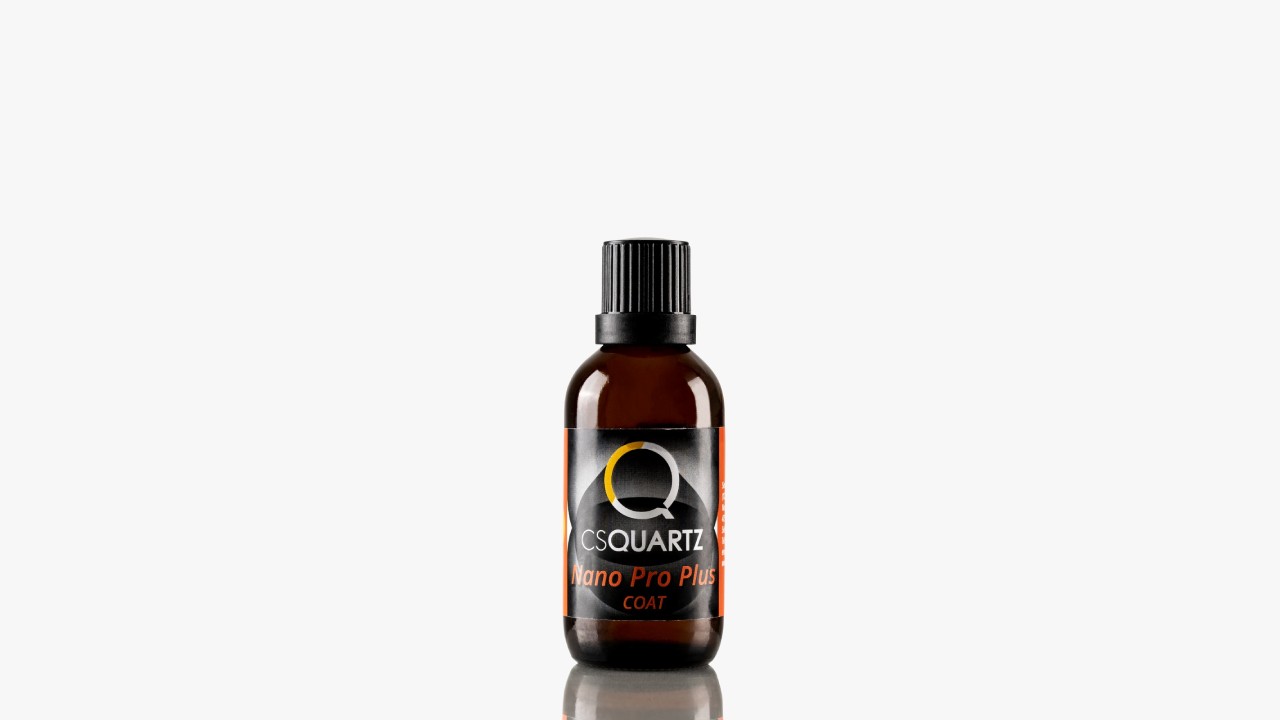
CS Quartz Nano Pro + 9H Ceramic
CS Quartz has been researching and developing the latest Revolution Bonding Technology (RBT) and Liquid Ceramic Technology (LCT) based on semi-conductor and photoelectric industrial technologies.
Revolutionary Bonding Technology RBT
Most of the protective coatings available in the market today are not viscous enough to adhere to
the substrate even though they are known for their basic dirt resistance and hydrophobic
properties. As soon as these coatings suffer some physical damage, they will be quickly dissolved
and separated from the substrate. Subsequently, the substrate will lose its protection.
RBT makes outstanding coating adhesion strength possible. The resulting adhesive strength is not
only a physical effect but also a chemical one. Cross-linking reaction occurs between the water
molecules in the atmosphere and the liquid ceramic. This reinforces adhesion of the coating to the
substrate which gives rise to the three-dimensional reticulated crystals.
The resulting coating features extremely powerful bonding energy. Hence it can remain
permanently on the surface. Even with smooth substrates, such as glass, complete adhesion is
possible. Also, the adhesive strength does not fade with time. Because of the RBT technology, the
CS Quartz Ceramic series can provide any material with permanent protection.
Liquid Ceramic Technology LCT
Ceramic materials are known for their robust physical properties and optimum tolerance of
chemicals. They can withstand extremely high temperatures (1,000°C~1,600°C) and retain their
mechanical strength despite harsh environmental conditions. This is why they are commonly
applied in many industrial fields. Ceramics, however, usually exist in the solid state.
Thanks to the patented LCT, solid-state ceramics can be turned into the liquid
state to make their storage and application easy.
When liquid ceramics are exposed to water
molecules in the air, the hydrolyzing condensation reaction turns liquid ceramics into a thin
transparent ceramic film to provide the substrate with excellent protection. Also, the coating does
not affect the substrate’s appearance and hence can be applied to a variety of materials.
Moreover,
the ceramic coating can significantly reduce the surface energy to make the object easy to clean
and highly water repellant. The thin ceramic film can also enhance surface rigidity to resist damage.